France votes on assisted dying: Archbishop Ulrich calls for renunciation, the Church prepares its resistance
FranceMembers only 17 h ago6Add to bookmarks
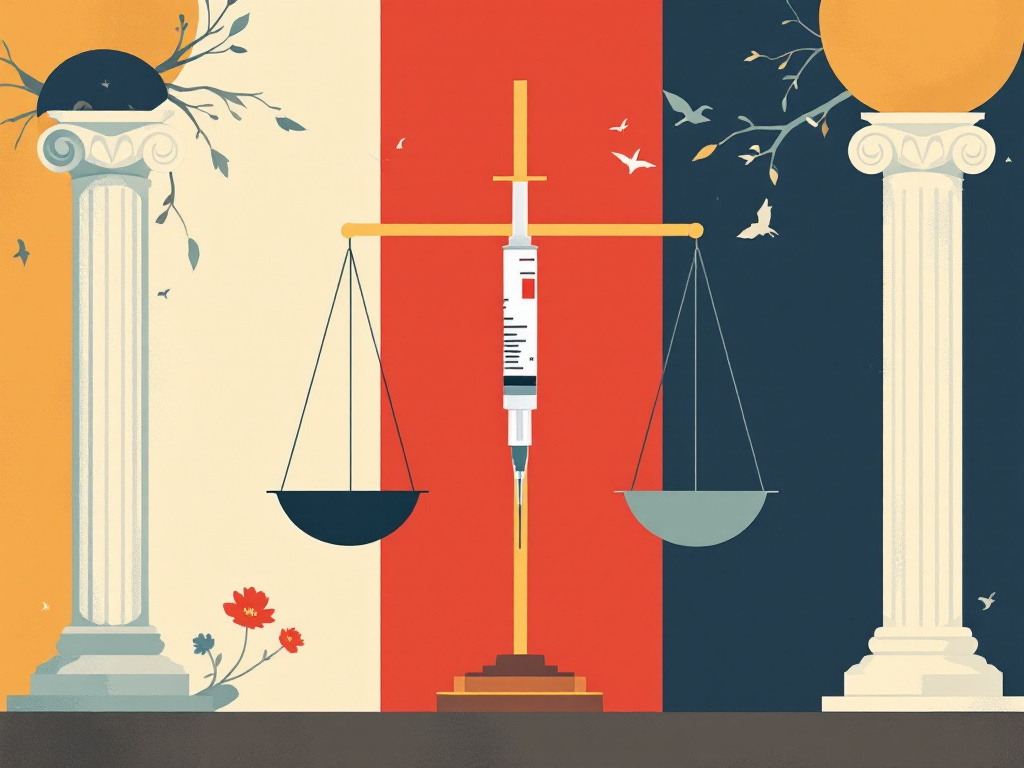
For the third time, the National Assembly has adopted the bill establishing a "right to assisted dying." The Archbishop of Paris calls for "abandoning this path." The Catholic Church is entering a phase of institutional resistance that the law now makes necessary.
Context
We had followed step by step the progress of this text: the parliamentary maneuvers, the all-out Catholic mobilization, the solemn appeal of Cardinal Sarah and the episcopate, the votes in joint committees, the setbacks and advances. June 30, 2026, marks the date feared by those who refuse to confuse death given with death assisted: the National Assembly adopted the text establishing a "right to assisted dying" for the third and final time. The law is now adopted.
The Facts
The solemn vote took place on June 30, 2026. Yaël Braun-Pivet, President of the Assembly, hailed the "culmination" of the debates. The text establishes a right to assisted dying for adults suffering from a serious and incurable illness, in an advanced or terminal phase, causing refractory suffering. The individual conscience clause is maintained—but healthcare institutions cannot collectively oppose it. Archbishop Laurent Ulrich of Paris responded by solemnly calling to "renounce this path." Généthique reports that medical voices continue to assert that "palliative care and euthanasia are incompatible and irreconcilable"—a distinction the law methodically erases.
Doctrinal Analysis
The Church has not wavered. Evangelium Vitae (John Paul II, 1995, n. 65) is explicit: "Euthanasia is a grave violation of the law of God, inasmuch as it is the deliberate and morally unacceptable killing of a human person." The Catechism of the Catholic Church reaffirms that "Whatever its motives and means, direct euthanasia consists in putting an end to the lives of handicapped, sick, or dying persons. It is morally unacceptable" (CCC 2277). The notion of "refractory suffering" as a criterion for access to induced death constitutes a door that no one can guarantee will remain narrow. Belgian and Dutch history demonstrates this with distressing regularity.
Stakes for the Church and the Faithful
The individual conscience clause is a partial victory. But the impossibility for a Catholic healthcare institution to collectively refuse the act constitutes a serious infringement on the Church's institutional freedom. This is the next front. Catholic institutions—FEHAP, Petites Sœurs des Pauvres, denominational retirement homes—will have to define their canonical and legal line of resistance. Catholic caregivers, for their part, face professional pressure that will only grow.
Critical Reading and Blind Spots
That the President of the Assembly hails the "culmination" of the debates reveals a vision of politics that confuses the irreversible with the definitive. A law can be repealed. What is less reversible is the habituation of consciences. This is the real danger: not the law itself, but the progressive normalization that will follow. Archbishop Ulrich's appeal is just—but it will be judged by the actions that follow. Episcopal words must now translate into concrete support for caregivers, families, and institutions.
To Reflect and Act
For the faithful, the response to this law is not discouragement, but commitment. Supporting palliative care homes, accompanying dying loved ones, educating one's conscience on the distinctions the law deliberately blurs: this is the concrete vocation of Catholics facing this new legal reality. The bishops have said no. It is up to each of us to give substance to this refusal.
Content reserved for members
Create a free account to access all our content and the weekly review.
Comments (6)
Sign in to join the discussion.

LecteurDuDimanche 01 Jul 2026 · 12:22
La loi passe, mais dans mon village, personne n’en veut.

le_veilleur 01 Jul 2026 · 15:02
C’est souvent comme ça : les lois s’écrivent loin des villages, mais c’est là qu’on voit si elles tiennent debout.

Th. Aubry 01 Jul 2026 · 04:55
Chez nous en Bretagne, on a toujours refusé qu’on nous impose des lois qui contredisent nos traditions. Aujourd’hui, c’est pareil : une loi venue de Paris ne changera pas ce qu’on vit depuis des siècles.

Clémence R. 01 Jul 2026 · 07:44
En Bretagne aussi on a nos traditions, mais on sait que la foi, elle, ne change pas. Une loi de Paris ne fera pas taire nos églises.
le_veilleur 01 Jul 2026 · 04:54
C’est bien joli de parler de soin de l’âme, mais quand on voit un proche souffrir sans espoir, c’est dur de ne pas se demander si on a le droit de le laisser comme ça.

unLecteur33 01 Jul 2026 · 04:50
C’est bien beau de parler d’aide à mourir, mais pourquoi on ne met pas plus d’argent dans les soins palliatifs ? Ça éviterait à des gens de demander ça par désespoir.

CurioBretagne 01 Jul 2026 · 09:57
C’est vrai, ça ! On parle d’aide à mourir, mais les services de soins palliatifs, ils sont toujours en sous-effectif. Un peu d’argent là-dedans, et beaucoup de gens n’auraient même pas à se poser la question.
Bénédicte77 01 Jul 2026 · 04:36
On nous parle de dignité de la vie, mais c’est quoi la dignité quand on attend 6 mois pour un rendez-vous en gériatrie ? L’Église ferait mieux de se battre pour ça aussi.

Ph. Renard 30 Jun 2026 · 19:54
C’est bien joli de parler de compassion, mais où est la vraie miséricorde quand on donne la mort ? Ma belle-sœur infirmière voit déjà des pressions sur les patients.
Story timeline
Aide à mourir : le référendum bloqué, l'Assemblée dans la semaine du vote
- 1Aide à mourir : le référendum bloqué, l'Assemblée dans la semaine du vote23/06/2026
- 2J-7 avant le vote : la SFAP dit non à l'aide à mourir23/06/2026
- 3L'aide à mourir franchit le Rubicon : l'Assemblée vote, Bayrou hésite, les soignants résistent23/06/2026
- 4L'aide à mourir : la motion de rejet échoue, le vote approche, la rue résiste23/06/2026
- 5L'aide à mourir au bord du vote : une chimère législative face à la conscience24/06/2026
- 6L'aide à mourir : la motion rejetée, le vote final approche - la rue dit non24/06/2026
- 7Pays-Bas : première euthanasie d'un enfant de moins de 12 ans - l'Europe franchit un seuil24/06/2026
- 8L'aide à mourir au bord du vote final : Mgr Aveline interpelle, la France bascule24/06/2026
- 9Aide à mourir, J-5 : le texte n'a pas bougé d'une virgule25/06/2026
- 10« Anesthésia » : quand le cinéma documentaire résiste à la loi sur l'aide à mourir25/06/2026
- 11Pays-Bas : premier enfant euthanasié depuis l'extension de la loi - à cinq jours du vote français25/06/2026
- 12Euthanasie : J-4 avant le vote, la rue dit non le 28 juin26/06/2026
- 13Aide a mourir : J-4, la rue dit non, le Parlement avance26/06/2026
- 14Aide à mourir : J-2 avant la manifestation, la loi passe au forceps26/06/2026
- 15Aide à mourir : les députés reviennent au suicide assisté - le vote solennel du 30 juin approche27/06/2026
- 16Aide à mourir : la clause de conscience des établissements supprimée28/06/2026
- 17Aide à mourir : à 48 heures du vote, l'incompatibilité radicale avec les soins palliatifs28/06/2026
- 18Aide à mourir : demain, la France franchit le Rubicon29/06/2026
- 19Vote du 30 juin : la France au seuil de l'irréversible29/06/2026
- 20La France vote l'aide à mourir : l'Église face à l'irréversible30/06/2026
- 21La France vote l'aide à mourir : Mgr Ulrich appelle à renoncer, l'Église prépare sa résistance30/06/2026
- 22L'aide à mourir votée : l'Église entre en résistance01/07/2026
- 23Aide à mourir : la loi adoptée, le Sénat résiste, les proches témoignent01/07/2026