Brexit, Ten Years On: The Temptation of Return and Its Impossible Conditions
EuropeMembers only Jun 23, 20266Add to bookmarks
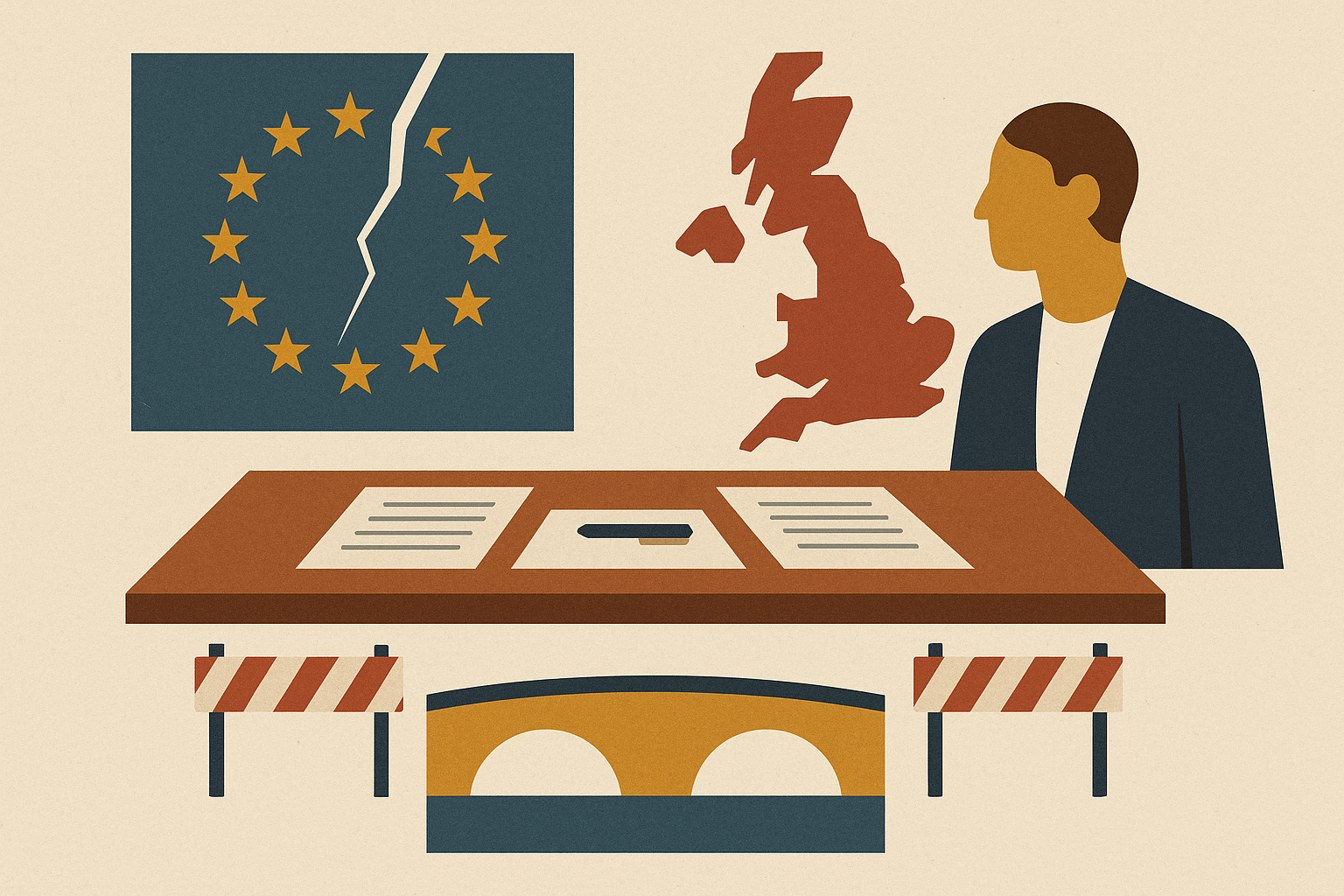
On June 23, 2016, the United Kingdom left the European Union. Ten years later, a majority of Britons regret this choice, Brussels displays its goodwill, but the conditions for a return are exactly what the "Leave" campaign had rejected. The lasting divorce sheds light on the deep fractures within the European project.
Context
On the tenth anniversary of the referendum, we had analyzed the lasting economic and political fractures introduced by Brexit into the European landscape. This June 23, 2026, current events demand an additional perspective: is a return possible, and at what institutional and democratic cost?
The Facts
The European Commission, Parliament, and Member States claim to be ready to "reset" relations with London (La Croix, June 23, 2026). Keir Starmer, the outgoing Prime Minister, had initiated this rapprochement before his resignation. Le Figaro (June 23, 2026) notes that a majority of Britons regret Brexit without necessarily wanting a full return to the EU: polls show that the cost of living and immigration have deepened the sense of failure. La Croix documents that ten years of Brexit have driven British poverty to a level unseen in thirty years. Former negotiator Michel Barnier tells Le Figaro: "The Brexit warning is that we must heed popular concerns."
Doctrinal and Substantive Analysis
The Church's social doctrine (Compendium of the Social Doctrine of the Church, nos. 435-436) emphasizes the principle of subsidiarity: nations should delegate to the Union only what they cannot achieve alone. Brexit revealed the EU's democratic legitimacy deficit—a question the Magisterium has raised since Centesimus Annus (John Paul II, no. 44): democracy must be substantive, not merely procedural. A union that fails to convince its members of its real utility cannot rely solely on rules.
The case of David Cameron illustrates the cost of political irresponsibility. As Le Figaro reminds us, the man who called the referendum has carefully kept his distance ever since. Playing with popular sovereignty without accepting the consequences is a fault that leaves lasting scars—a lesson in political philosophy that natural law has articulated since Aristotle.
Stakes for the Church and the Faithful
The question of EU-UK rapprochement directly concerns Catholics for two concrete reasons: the presence of a significant Catholic community across the Channel, whose rights under revised European law are at stake, and the question of the subsidiarity model the Church calls to defend against Brussels' technocracy.
Critical Reading and Blind Spots
Brussels claims to be ready to welcome rapprochement, but "under conditions": acceptance of the acquis communautaire, budget contributions, free movement. These conditions are precisely what the "Leave" vote rejected. The rapprochement risks being a political mirage sustained for electoral reasons, without addressing the underlying democratic deficit that made Brexit possible.
To Reflect and Act Upon
Ten years are enough to measure the cost of a decision made in anger and on false promises. If Europe wants to endure, it must resolve the democratic trust crisis that Brexit has made visible. Catholics can contribute by defending a vision of European unity rooted in its Christian foundations and the principle of subsidiarity, not merely in institutional mechanics.
• 52% of Britons regret Brexit (YouGov, June 2026)
• Poverty rate in the UK: 22% (highest since 1996)
• 68% of Europeans support a 'reset' with the UK (Eurobarometer, June 2026)
The principle of subsidiarity (DSE n°185-186) requires that decisions be taken at the most appropriate level, neither too distant nor too centralized.
Content reserved for members
Create a free account to access all our content and the weekly review.

Comments (6)
Sign in to join the discussion.

Marta_Torino 26 Jun 2026 · 15:09
Dix ans après, les Britanniques râlent, mais Bruxelles ne va pas leur faire de cadeau. On ne rentre pas dans l’UE comme dans un moulin.

Léa75 26 Jun 2026 · 11:05
Dix ans après, c’est vrai que les Britanniques ont l’air de se mordre les doigts… Mais bon, comment revenir en arrière sans tout casser encore plus ?

J.P.R. 25 Jun 2026 · 14:56
Dix ans après, les Britanniques voient bien que ça a tout compliqué... Mais revenir maintenant, ce serait encore pire que de partir à l'époque.

le_sceptique 25 Jun 2026 · 14:33
Dix ans après, tout le monde voit que c’était une erreur, mais personne n’a le courage de le reconnaître franchement, ni à Londres ni à Bruxelles.

sophie.b 25 Jun 2026 · 14:15
Dix ans après, les Britanniques se rendent compte que c’était plus simple sur le papier. Maintenant, ils voudraient revenir, mais Bruxelles ne va pas leur dérouler le tapis rouge.

CurioBretagne 24 Jun 2026 · 08:35
Dix ans après, les Britanniques regrettent, mais Bruxelles ne va pas leur faciliter les choses. Ça promet.
Story timeline
Brexit 10 ans : le bilan d'un divorce européen
- 1Brexit, dix ans après : l'Europe face à ses propres fractures23/06/2026
- 2Dix ans de Brexit : une pauvreté aggravée, un rapprochement conditionné, un avertissement pour l'Europe23/06/2026
- 3Brexit, dix ans après : la tentation du retour et ses conditions impossibles23/06/2026
- 4Brexit, dix ans après : le retour est possible, mais à quel prix pour qui ?24/06/2026