Embryoids with Cardiac Chamber: How Far Will Science Go Without Man?
IntelligencesMembers only Jun 29, 20266Add to bookmarks
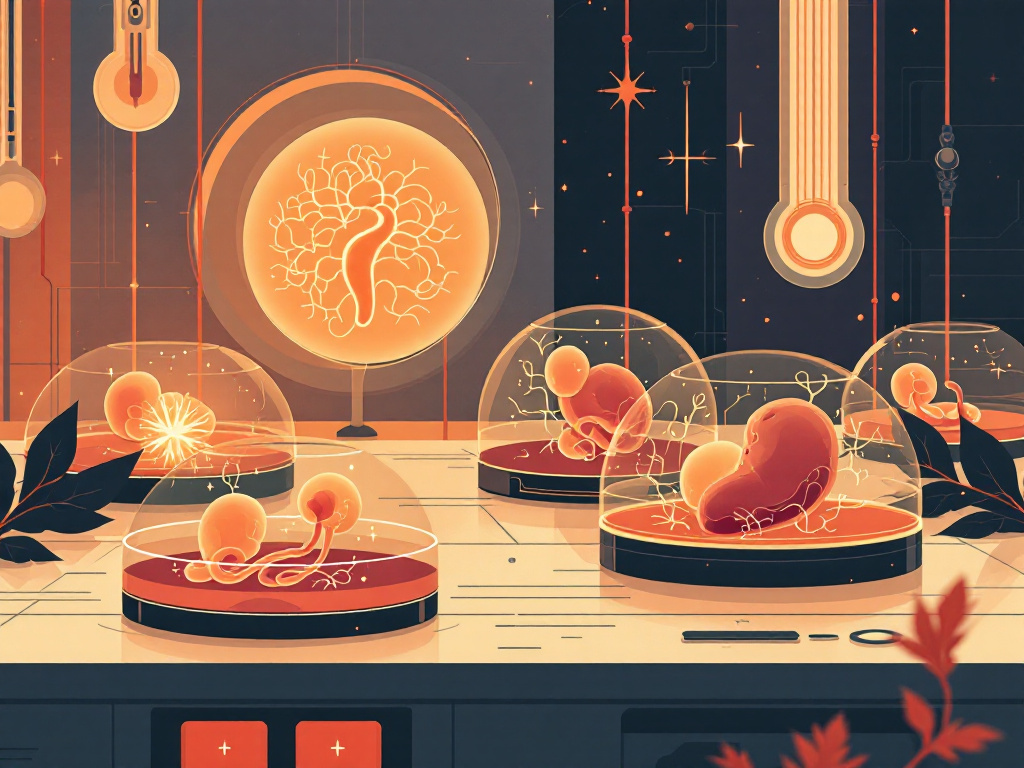
Researchers have just created embryoids capable of developing neural tubes, organ precursors, and even a primitive cardiac chamber that contracts autonomously. Marie-Thérèse Bonnet analyzes this crossing of boundaries in the name of Thomistic realism.
Context
We had been following the trajectory of this thread: misoprostol prescribed alone, the National Academy of Medicine opposing paid gametes, the symbolic confrontation between the legacy of Jérôme Lejeune and the utilitarian logics of contemporary reproductive biology. The news published by Généthique on June 29 represents a qualitative leap: embryoids now develop a primitive cardiac chamber that contracts autonomously.
The Facts
According to the published data, teams of researchers have succeeded in developing embryoids—synthetic structures built from stem cells, without the fertilization of an oocyte—with neural tubes, organ precursors, and a functional primitive cardiac chamber. These structures are not human embryos in the classical sense, but they increasingly mimic early development with growing fidelity. The boundary between "model" and "organism" becomes thinner each day.
Doctrinal Analysis
The question raised by this research is precisely the one that Donum Vitae (1987) and Dignitas Personae (2008) formulated with clarity: respect for the human person begins at the very start of biological life, regardless of the mode of conception. The Magisterium has not yet ruled on embryoids as such, but the applicable principles are clear: any entity whose biological status approaches that of the human embryo must be treated with the respect due to the dignity of the person (Dignitas Personae, n. 5). That a cardiac chamber beats autonomously is not a technical detail: it is an anthropological question of the first order.
Stakes for the Church and the Faithful
The Church is the only global institution with a coherent anthropological framework to respond to these advances. Thomistic realism—the human being as a unity of body and soul, not as a sum of biological functions—provides the necessary intellectual resources. But this assumes that Christians engage in scientific debate with competence, rather than settling for reactive positions. Ethics committees, Catholic medical faculties, and Catholic biologists each have a specific responsibility here.
Critical Reading and Blind Spots
The term "embryoids" is precisely designed to evade the question of moral status. We name things differently to treat them differently—a classic rhetorical device already denounced by C.S. Lewis in The Abolition of Man. The question is not "Is this an embryo in the legal sense?" but "Is this an entity whose destruction requires serious moral justification?" The Thomistic answer is: yes, as soon as it mimics the development of a human person.
To Reflect and Act Upon
"You formed me in my mother’s womb" (Ps 139:13). Life does not wait for bioethical debate to exist. Catholic scientists, physicians, and philosophers are called to clearly name what is at stake—not out of confessional reflex, but out of a demand for truth. Supporting associations that do this work—Généthique, Alliance VITA—is both an intellectual and a spiritual act.
- **Embryoids** now develop functional primitive cardiac chambers.
- The **boundary between model and organism** is increasingly blurred.
- The **Church’s anthropological framework** remains the most coherent response.
- The term **'embryoid'** is a rhetorical tool to avoid moral questions.
Content reserved for members
Create a free account to access all our content and the weekly review.

Comments (6)
Sign in to join the discussion.

Marie47 30 Jun 2026 · 04:52
Un cœur qui bat dans une boîte, ça fait bizarre. On dirait qu’on joue aux apprentis sorciers.

Th. Aubry 29 Jun 2026 · 17:10
Un cœur qui bat tout seul en boîte, ça me fait froid dans le dos. Où on met la limite entre une expérience et quelque chose qui respire ?

J.P.R. 29 Jun 2026 · 16:59
Créer des cœurs qui battent en labo, c'est impressionnant, mais est-ce qu'on ne joue pas aux apprentis sorciers ? Où est la limite entre recherche et démesure ?

passionné_eco 29 Jun 2026 · 16:47
Ces cœurs qui battent tout seuls, ça me glace. On se demande vraiment où s’arrête la recherche et où commence l’orgueil.

Léa75 29 Jun 2026 · 13:32
C’est vrai que ça fait réfléchir… On se croit tout-puissants, mais au fond, on ne maîtrise même pas ce qu’on crée.

Clémence R. 29 Jun 2026 · 13:23
Un cœur qui bat en labo, sans âme, ça me fait froid dans le dos. On joue à Dieu ou quoi ?
Story timeline
Misoprostol seul et Jérôme Lejeune : deux visions de l'homme face à face
- 1Misoprostol seul et Jérôme Lejeune : deux visions de l'homme face à face23/06/2026
- 2René Frydman l'admet : commercialiser le corps, c'est tout commercialiser23/06/2026
- 3GPA : une coalition d'États porte à l'ONU l'appel à un moratoire mondial en vue de l'abolition25/06/2026
- 4Léon XIV et Jérôme Lejeune : "La valeur de la personne ne dépend pas de ce qu'elle réalise"25/06/2026
- 5PMA : l'Académie de médecine contre l'importation de gamètes, ou quand la raison rejoint le magistère25/06/2026
- 6Embryoïdes avec chambre cardiaque : jusqu'où ira la science sans l'homme ?29/06/2026