An Europe detached from the Gospel risks "committing suicide": John Paul II's warning becomes relevant again
EuropeMembers only Jun 26, 20265Add to bookmarks
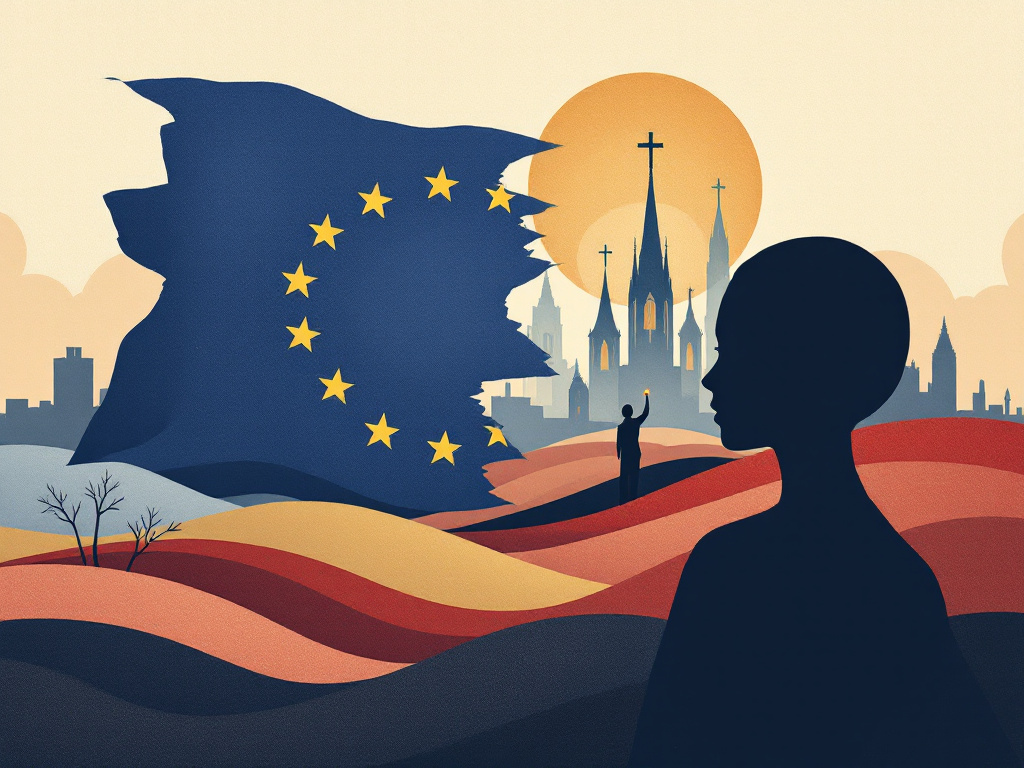
At a time when the European Union is debating its founding values and the COMECE is multiplying calls to reconnect with the continent's Christian heritage, John Paul II's prophetic statement about Europe "committing suicide" by breaking with the Gospel regains a striking acuity.
Verified Facts
A quote attributed to John Paul II is being recalled in the European Catholic debate at the start of summer 2026: "A Europe detached from the Gospel risked committing suicide by surrendering to its own downfall."
This formulation, echoed in the wake of positions expressed by COMECE (Commission of the Bishops' Conferences of the European Union) during its spring plenary assembly, is circulating in several European Catholic media outlets as a diagnosis that the EU's institutional news confirms week after week.
The political context is clear: the Irish presidency of the EU (Ireland = the first Catholic country to legalize abortion by referendum in 2018 and same-sex marriage in 2015) is being called upon to "remind the EU of its Christian origins." The COMECE Youth Net, bringing together young Catholics from across Europe in Brussels, has placed this question at the heart of its work. The Taliban were received in Brussels for an official visit to discuss immigration, illustrating the disorientation of values in the European institutional discourse.
Analysis of Underlying Issues
The Christian institutional heritage of the EU is not an optional extra. The founding fathers of European construction—Konrad Adenauer, Alcide De Gasperi, Robert Schuman (in the process of beatification)—were convinced Christian Democrats. Their vision of Europe was rooted in the dignity of the human person as defined by Thomist philosophy and Catholic social doctrine. This is not a historical anecdote: it is the institutional DNA of the European project.
Progressive disengagement. Since the debates on the European Constitution of 2004–2005 (refusal to include Christian roots in the Preamble), European institutions have adopted a neutrality that quickly turns into hostility: funding of anti-religious projects with European funds, pressure on Member States that maintain legislative protection of conscience, promotion of reproductive rights that directly conflict with religious freedom.
The paradox of the Irish presidency. Ireland is being called upon, during its rotating presidency, to remind Europe of its Christian roots. Yet it is Ireland that, within the space of ten years, has legalized same-sex marriage (2015), abortion (2018), and is preparing to go further on euthanasia. This paradox is not Irish: it is European. The ability to remember one's roots assumes they have not been entirely severed.
European Catholic youth as a counter-sign. The COMECE Youth Net, bringing together young Catholics from twenty-seven countries in Brussels, represents a reality that European institutions prefer to ignore: there exists in Europe a living, committed Christian youth that does not recognize itself in the discourse of rights without foundation and values without content. This network is discreet. It is real.
Doctrinal Insight
John Paul II devoted an entire apostolic exhortation to Europe: Ecclesia in Europa (2003). He wrote that Europe "needs to reread its history in a way that allows it to rediscover the guiding thread of its Christian tradition" (EiE, n. 109). And further: "Without the nourishment of the Word and the sacraments, Europe risks becoming spiritually arid, unable to pass on to future generations what made it great" (EiE, n. 57).
Benedict XVI, in his speech to the European Parliament in Strasbourg on 25 November 2014, reiterated this diagnosis: European institutions risk losing their soul if they cut the thread that connects them to their moral and spiritual heritage. This is not a political judgment. It is an analysis of political philosophy that the Catholic tradition has upheld since Thomas Aquinas.
The doctrine of subsidiarity (Rerum Novarum, Centesimus Annus) reminds us that European institutions cannot substitute for nations, families, and Churches in the transmission of values. They can create favorable conditions. They cannot create the content.
Points for Reflection
Europe is experiencing an identity crisis that is not merely economic or geopolitical. It is anthropological and spiritual.
John Paul II's formula about the "suicide" of a Europe without the Gospel is not alarmist rhetoric. It is a clinical description: a civilization that no longer knows why it exists, and therefore cannot transmit reasons for living to its children, empties itself.
For European Catholics, the response is not nostalgic. It is missionary. It is not about reclaiming institutional privileges. It is about proposing once again, in the European public square, a vision of man and the city based on the inalienable dignity of every person.
The COMECE Youth Net has understood this. The question is whether Brussels will listen.
Contemplating Europe today, I see a call to renew hope. Europe has been evangelized and has evangelized the world. It can do so again, if it rediscovers its roots.
Content reserved for members
Create a free account to access all our content and the weekly review.
Comments (5)
Sign in to join the discussion.

sophie.b 28 Jun 2026 · 08:47
C’est vrai que l’Évangile porte une lumière, mais est-ce que l’Europe ne pourrait pas simplement retrouver un peu de bon sens et de respect sans tout ramener à la foi ?

C.M. 27 Jun 2026 · 19:28
Sans l'Évangile, l'Europe tourne en rond. On le voit bien avec toutes ces lois qui nous éloignent de ce qu'on était.

CurioBretagne 27 Jun 2026 · 14:50
Un arbre sans racines finit par tomber, c'est sûr. Mais est-ce qu'on doit vraiment faire de l'Évangile une loi pour toute l'Europe ?

passionné_eco 26 Jun 2026 · 18:10
Sans le christianisme, l’Europe n’est plus qu’un marché sans but. On le voit bien aujourd’hui, non ?

Léa75 26 Jun 2026 · 16:43
C’est vrai que quand on voit ce qui se passe en Irlande, on se dit que Jean-Paul II avait raison… Une Europe sans l’Évangile, c’est comme un bateau sans gouvernail.
Story timeline
Jeunesse catholique et institutions européennes : la COMECE forme ses relais
- 1COMECE Youth Net : la jeunesse catholique face aux défis européens24/06/2026
- 2L'Irlande prend la présidence de l'UE : une occasion historique de rappeler les racines chrétiennes de l'Europe24/06/2026
- 3Le diocèse de Saint-Gall veut une "papesse" : une dérive européenne qui défie Ordinatio Sacerdotalis24/06/2026
- 4Une Europe coupée de l'Évangile se condamne elle-même : la mise en garde qui résonne26/06/2026
- 5Une Europe detachee de l'Evangile risque de "se suicider" : l'avertissement de Jean-Paul II redevient d'actualite26/06/2026